One plan per surface
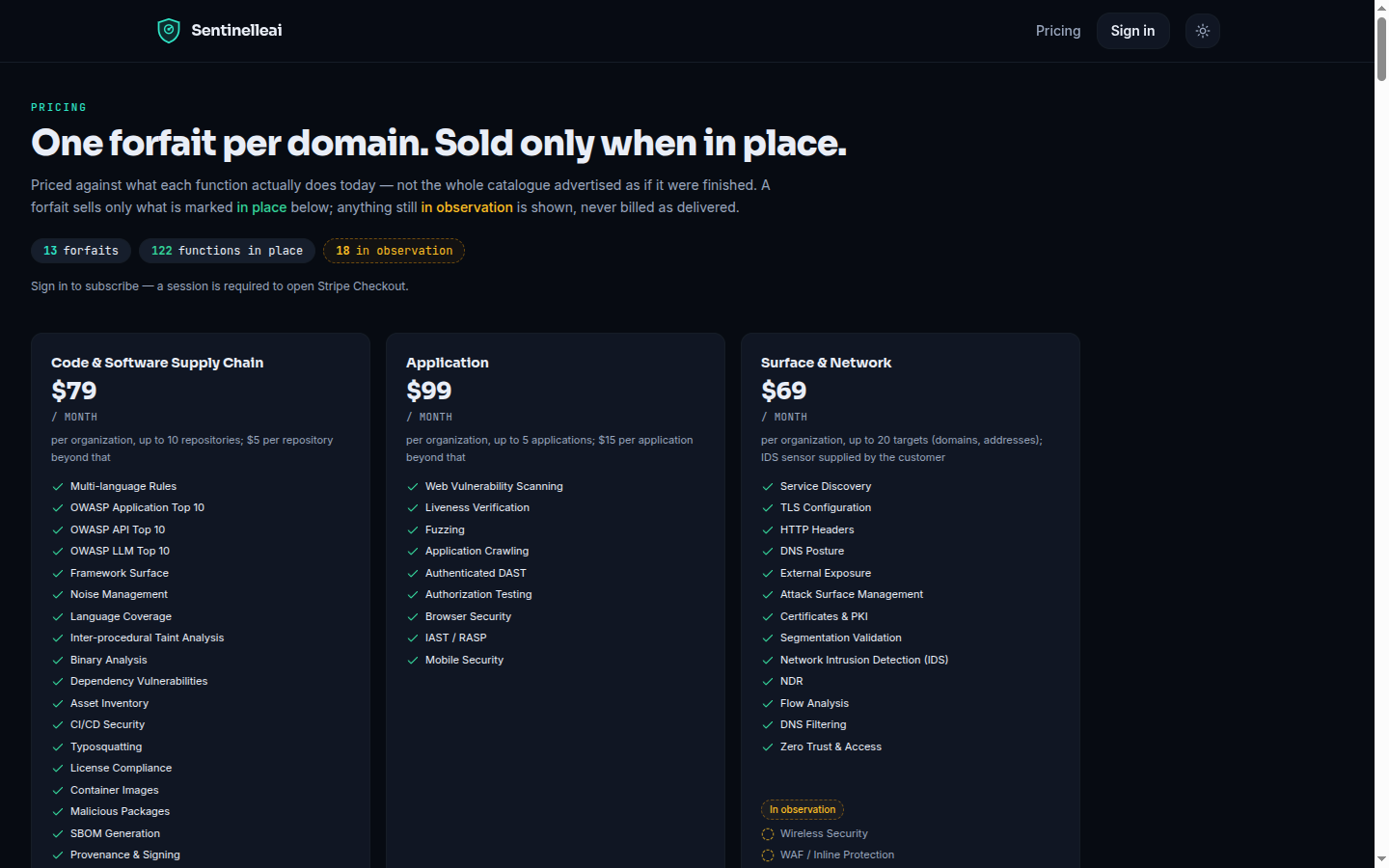
Each scanning surface — code and software supply chain, application, surface and network, cloud and containers, host and ransomware, identity and data, compliance and governance, operations and response, offensive validation, smart contract verification, web3 monitoring, AI and agents, and email and CEO fraud — is its own monthly (or, for hosts, per-host) plan. A plan only ever sells the functions verified as actually delivered; anything still being built is shown on the same page marked "in observation" so you can see the roadmap, but it is never billed as delivered. See the pricing page for current amounts and the full function-by-function table.
The bundle
A single bundle plan — "Sentinelleai Complete" — grants every one of the recurring (monthly or per-host) plans at once, at its base level. Two things it does not include, even for a bundle subscriber:
- The per-contract smart contract verification is billed per event regardless of the bundle — a contract verification is a one-time, degressively-tiered charge, not a recurring plan, so it sits outside what a monthly bundle grants.
- Auto-pause is never included in the bundle. It moves a money-bearing contract on your behalf, so it is always an explicit, standalone opt-in rather than something a bundle purchase turns on implicitly.
Consent at subscription
Auto-pause, Site lockdown, and Host containment each act on your own production — a contract, a server, or a process and network on that server — on your behalf. Subscribing to any one of them for the first time requires signing a consent before checkout will proceed: the full instructions for that protection, a link to its documentation, and a phrase you must type verbatim confirming you read them. Checkout refuses to start without it and tells you which consent is missing.
The consent is recorded once per protection, against your identity, in the same append-only evidence ledger every other protective action uses — see the evidence ledger. It is not re-collected on every renewal, only the first time you subscribe to that protection.
That same consent text, exactly as you signed it, is attached to every incident report Sentinelleai sends you for that protection — see Reports sent to you.
Add-ons billed per run
Two add-ons are charged per run rather than as a subscription, and both reserve their charge before the run and release it back if the run does not complete — so a run that could not finish (the model was unavailable, the toolchain was missing, the baseline did not qualify) is never billed:
- Deep contract verification — mutation testing plus Echidna invariant fuzzing against your own repository, offered only when the repository structurally qualifies (a green Foundry test suite for mutation testing, an invariant harness for Echidna). One purchase buys a fixed number of runs; a run is counted as consumed only once it actually completes.
- Web reasoning panel — a read-only, multi-model reasoning pass over a completed web scan's deterministic findings. Same accounting: a purchase buys a number of runs, and a run is consumed only when the reasoning pass reports it finished.
Per-contract verification tiering
The smart contract verification is priced per contract on a degressive, tiered schedule: the first band of contracts costs the most per contract, and each subsequent band costs less. The tiering is cumulative within a calendar month — buying ten contracts across ten separate orders in the same month costs exactly the same as buying all ten in one order, because the count carries forward from whatever you have already been billed for that month. At the start of the next calendar month, the count resets and the first contract of the new month is billed at the first tier again.
Host and organisation plans
The host and ransomware plan is priced per host, with a fixed monthly minimum below which the price does not drop regardless of host count — so a single host still costs the floor price, not a fraction of the per-host rate.
Organisation plans are priced per seat, each with its own seat minimum, and pool a set of the individual plans across every member under one bill — see Accounts & access for how membership and data ownership work. A larger organisation tier is available on request for teams needing custom terms.
"In place" versus "in observation"
Every function a plan could ever sell is tracked against the code that actually runs it. A function marked in place is sold today, as part of the plan it belongs to. A function marked in observation is shown on the same plan for transparency — it is on the roadmap — but it is never billed as delivered, and it carries no charge of its own until it is verified as actually working. A function that is neither is not listed anywhere; nothing is sold on the strength of a name alone.
How billing actually works
Practical mechanics, independent of any specific amount:
- Prices are in USD; Sentinelleai does not add tax to any invoice.
- Subscribing opens a Stripe-hosted Checkout page. Card details are entered on Stripe's own page and never touch Sentinelleai's servers.
- Cancelling or changing a plan goes through the Stripe Customer Portal (the "Manage billing" button), where plans, payment methods, and cancellation are all handled directly with Stripe.
- A subscription that falls into a failed-payment state still grants its plan for a short grace period afterward, rather than cutting access off the instant a card fails — but it does not grant indefinitely; a subscription that stays unresolved eventually stops granting.